

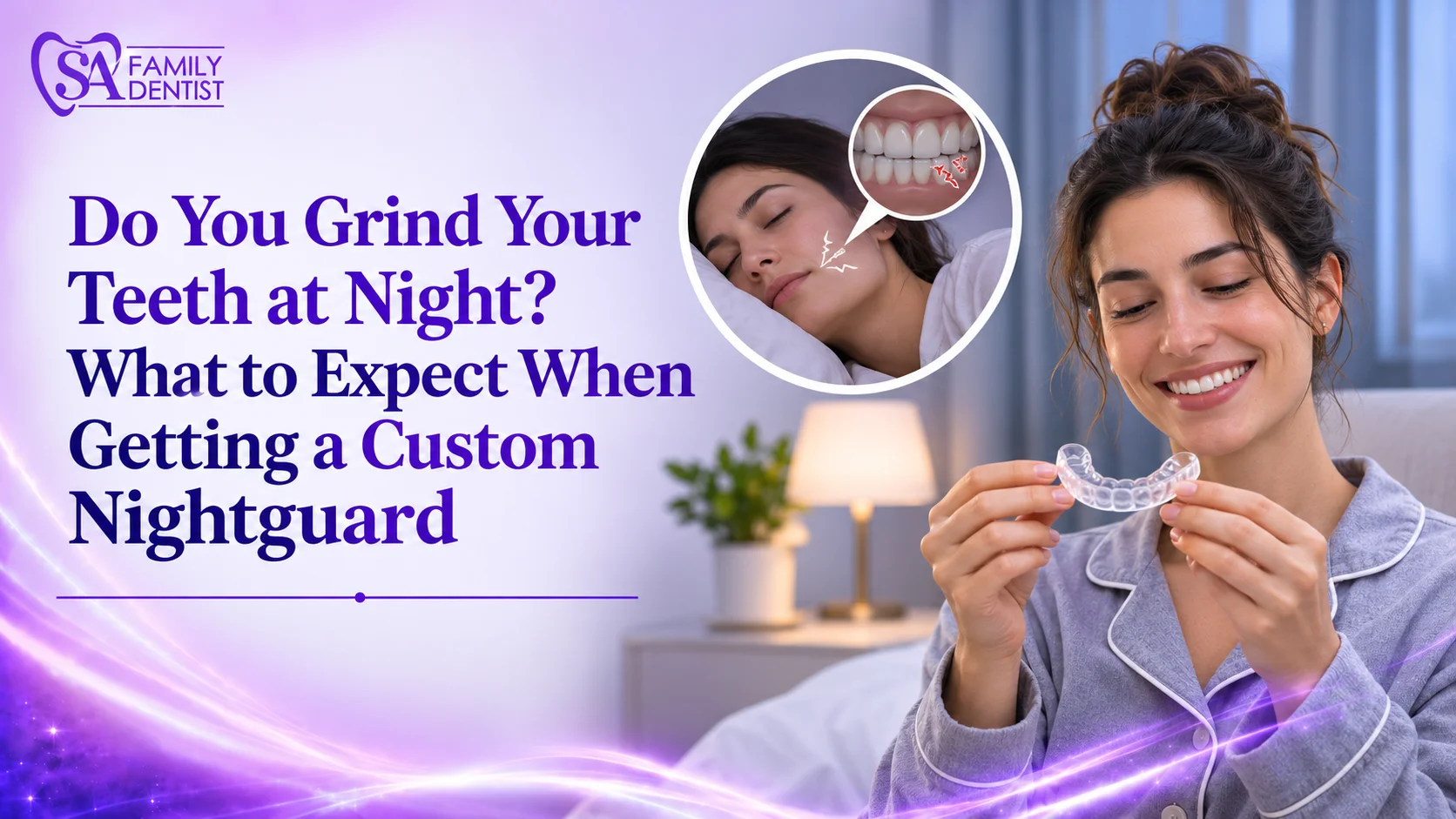
Here’s a pattern a lot of patients describe. You wake up and your jaw feels like it ran a marathon overnight. Maybe there’s a headache too. You blame the pillow, or work, or that second cup of coffee, and you move on. Then it happens again. And again.
If that sounds familiar, you may be grinding or clenching your teeth in your sleep. The dental word for it is sleep bruxism, and most people who have it don’t know. You’re asleep, after all.
Dentists often catch it first. Teeth that look flattened. Tiny chips along the edges. Fillings that wear down faster than they should. Jaw muscles that are sore when we press on them. Those are the clues.
The usual thing we reach for is a custom nightguard, though “fix” isn’t quite the right word for it (more on that below). It’s a thin appliance made from scans or impressions of your own teeth. It is not the boil-and-bite kind from the drugstore. It sits between your upper and lower teeth so they can’t grind against each other. Your jaw might still clench. Your enamel just stops taking the beating.
If you’re looking for a dentist in San Antonio, Texas because you think you grind at night, here’s how it goes from start to finish.
How do you know if you need a nightguard?
Honestly, most people don’t know. Sometimes a partner says you sound like you’re chewing gravel. More often the dentist spots the wear during a regular cleaning and asks about it.
What to watch for: teeth that look flat or shorter than they used to, chips you can’t explain, a tired jaw in the morning, teeth that suddenly zing with hot or cold, a sore face, or headaches that keep coming back.
One caution, though. Those symptoms can come from other things. Jaw pain has plenty of causes, and the National Institute of Dental and Craniofacial Research (NIDCR) says there isn’t much solid evidence that nightguards help TMD pain itself. So please don’t order a guard online and assume the problem is handled. Get checked first.
At SA Family Dentist, nightguards are part of our general dentistry services. We also do exams, cleanings, imaging, and TMD evaluations, which means we can figure out what’s really going on before making anything.
What the appointments are like
The first visit isn’t really about the guard. It’s about you.
We look at your teeth, gums, old fillings and crowns, your bite, and the muscles in your jaw. We’re hunting for worn enamel, cracks, damaged dental work, and any spots where your bite lands harder than it should.
Then we take a scan or impression. We use digital and 3D imaging across the practice, and it helps the guard match your mouth closely.
When the guard is ready, you come back and try it on. We check how it sits, how your top and bottom teeth meet it, and we adjust until it feels steady. Depending on your mouth, it could be a harder or softer material, and it could go on your upper or lower teeth.
The first few nights will feel odd. Think of sleeping in a retainer for the first time. That part is normal.
This part isn’t: pain that doesn’t go away, a bite that feels different, or a guard that keeps falling out in the night. NIDCR says to stop using an appliance that hurts and call your dentist. We’d say the same. Call us.
Why bother protecting your teeth?
Because enamel doesn’t grow back.
Grind all night, every night, and you slowly wear down your teeth and anything bonded to them. That can mean sensitivity, chips, fractures, and eventually crowns if the damage gets serious enough.
If you’ve spent real money on veneers or crowns, it matters even more. Nobody wants to chip a brand-new veneer while they’re sleeping. Implants are the same story. If you grind, tell us, and we’ll talk about a guard as part of keeping them healthy for the long haul.
Sometimes the damage is already there by the time someone comes in. A cracked tooth may need more than a guard. And if the pulp inside a tooth is infected or badly damaged, a root canal may be the way to save it.
Sudden, severe pain? Swelling? A tooth that just broke? Don’t wait for a nightguard appointment. That’s emergency dentistry.
Aligners, retainers, and your gums
If you wear clear aligners, or just finished braces, say so before we make a separate guard. Aligners and retainers are custom appliances too, so we have to think about tooth movement, retention, and grinding together. We offer custom clear aligner treatment with 3D imaging and ongoing monitoring.
Your gums count, too. A guard hugs your teeth all night, so you want healthy gums under there. If yours need attention, we provide periodontal care: scaling, root planing, and ongoing maintenance.
The bigger point is that a nightguard visit is really a look at your whole mouth. Your bite, your fillings, your cosmetic work, your gums, your implants, your aligners. It’s all connected.
What a nightguard won’t do
It protects. That’s the main job. Keeping your teeth apart cuts down the tooth-on-tooth damage from clenching and grinding. Some people also notice calmer jaw muscles, but not everyone does.
It isn’t a cure. Stress, poor sleep, certain habits, medications, and other health conditions can all feed into bruxism. NIDCR notes that some people with suspected sleep bruxism may need a closer look, including a sleep assessment if their symptoms point toward sleep apnea.
So if you also snore loudly, gasp, seem to stop breathing for a few seconds, or feel wrecked during the day, tell us. A grinding guard is not a sleep apnea device. Those need a medical diagnosis and teamwork between your doctor and your dentist.
SA Family Dentist serves San Antonio patients at its Braun Road, Nacogdoches Road, and Jackson Keller Road locations. If nighttime grinding or clenching is beginning to affect your teeth or comfort, you can schedule an appointment to have the problem evaluated and learn whether a custom nightguard makes sense for your situation
Frequently asked questions about custom nightguards
1. Is a custom nightguard better than a drugstore one?
Usually, yes, for one simple reason: it’s made from your teeth. We can check the fit and the contact points. Store-bought guards aren’t made that way. If you have a lot of wear, dental work, jaw symptoms, or other worries, get a dentist’s opinion first.
2. Will a nightguard stop me from grinding?
Not always. Its main job is to protect your teeth. It may calm the muscles for some people, but the grinding itself can carry on.
3. Can grinding crack a tooth?
It can contribute. Years of grinding wear teeth down and can weaken them. Bruxism is one of the factors we link to cracked or weakened teeth.
4. Can I wear one with crowns, veneers, or implants?
Often, yes. We just plan the guard around the work you already have. If you have restorations or implants, there’s even more reason to limit harmful forces at night.
5. What if my nightguard hurts?
Call your dentist. Don’t tough it out. A guard that causes ongoing pain may need an adjustment or a second look.
6. Where can I get a custom nightguard in San Antonio?
SA Family Dentist offers nightguards as part of our general dentistry at three San Antonio locations. If you wake up with jaw tension, sensitive teeth, headaches, or signs of tooth wear, come in for an exam. We’ll help you work out whether a custom nightguard, or something else, makes sense for you.