
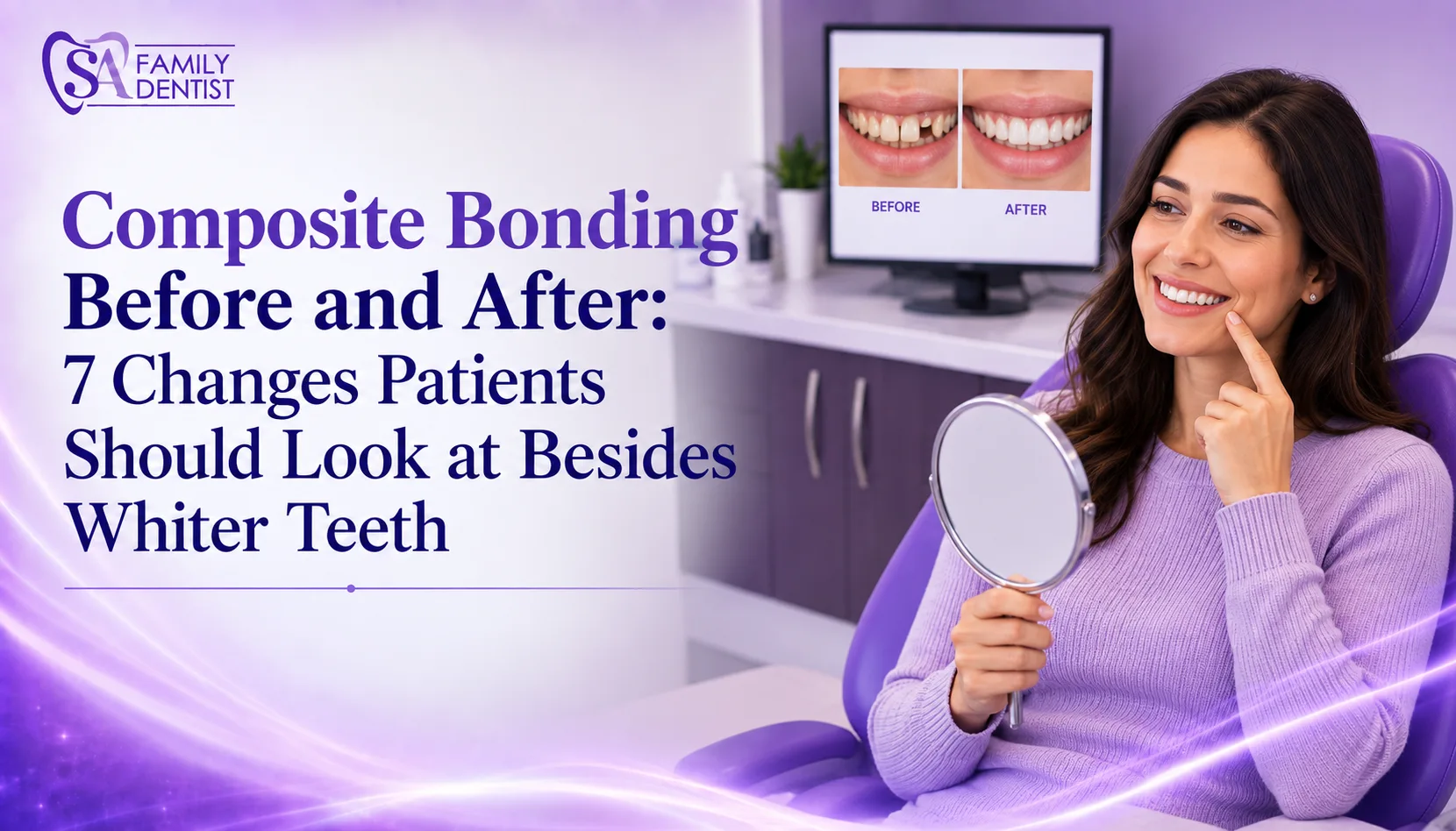
When people compare composite bonding before-and-after photos, tooth color often gets most of the attention. But bonding can be used to address much more than shade. If you are considering treatment with a cosmetic dentist nearby, look closely at tooth shape, edges, spacing, symmetry and how naturally the treated teeth fit with the rest of the smile.
Composite bonding uses tooth-colored resin that is applied and shaped on the tooth. Depending on the patient’s needs, it may help improve small chips, gaps, uneven edges and other cosmetic concerns.
So, what should you actually look for in the mirror or in before-and-after photos?
1. Are Chipped Edges Less Noticeable?
A small chip can make an otherwise healthy-looking smile appear uneven.
Composite bonding may be used to rebuild the missing area and create a smoother tooth edge. When comparing results, do not simply check whether the chip has disappeared. Look at whether the repaired area follows the natural shape of the surrounding tooth.
The goal should be a tooth that does not immediately draw attention to the repair.
2. Do the Teeth Look More Even in Length?
Sometimes one front tooth appears slightly shorter than the tooth beside it. This may be natural, or it can happen because of minor wear or damage.
Bonding can sometimes add material to selected areas to create a more balanced appearance.
Look at:
- The length of the front teeth
- Whether one tooth still stands out as unusually short
- How smoothly the lower edges line up
- Whether the result still looks natural rather than overly uniform
Small changes in length can make a noticeable difference to the overall smile.
3. Have Small Gaps Been Reduced?
Not every space between teeth requires orthodontic treatment. For certain small gaps, composite bonding may be an option.
Resin can be added to the sides of selected teeth to reduce visible spacing. However, closing a gap is not simply about filling empty space.
A cosmetic dentist nearby also needs to consider the final width and proportion of the teeth. Closing a gap too aggressively can leave the teeth looking unusually wide.
That is why proportion matters just as much as the size of the gap.
4. Has the Shape of Individual Teeth Improved?
Natural teeth are rarely identical. Still, one tooth may be noticeably narrower, shorter or differently shaped from those around it.
Composite bonding can sometimes reshape these areas without changing every tooth in the smile.
A useful before-and-after comparison should ask whether the altered tooth now blends better with neighboring teeth. Good cosmetic treatment should respect the person’s existing smile rather than make every tooth look exactly the same.
5. Are Worn or Uneven Edges Smoother?
Years of normal use can change the edges of teeth. Grinding, clenching and other habits may also contribute to wear.
Bonding may help restore certain worn or irregular areas when clinically appropriate.
But there is an important consideration here. If tooth grinding caused the damage in the first place, simply repairing the appearance may not address the reason it happened.
This is why cosmetic assessment should include more than appearance alone.
6. Does the Bonding Match the Surrounding Teeth?
Color still matters, but not only in terms of making teeth look whiter.
Composite resin should blend with the surrounding teeth. An area that is significantly brighter, duller or more opaque than neighboring enamel can become noticeable for the wrong reason.
When evaluating results, pay attention to:
- Shade consistency
- How the restoration looks in normal lighting
- Whether the bonded area blends into the natural tooth
- Whether treated and untreated teeth work together visually
The most noticeable result is not always the most natural result.
7. Does the Entire Smile Look Balanced?
This is the detail patients sometimes miss.
You can technically improve several individual teeth and still end up with a smile that feels visually unbalanced. Teeth have to work together in terms of size, shape, position and proportion.
Before choosing a cosmetic dentist nearby, discuss what specifically bothers you about your smile rather than simply asking for bonding. A proper assessment can determine whether bonding is appropriate for those concerns or whether another treatment would make more sense.
What Composite Bonding Cannot Fix
Bonding is useful, but it is not the answer to every cosmetic concern.
Depending on the condition of your teeth, problems involving significant tooth damage, major alignment issues, your bite or other oral health concerns may require a different approach.
The first question should therefore be, “Is bonding suitable for my teeth?” rather than, “How many teeth should I bond?”
Look Beyond a Brighter Smile
A strong composite bonding result is about more than making teeth appear whiter. Shape, spacing, proportion, edges and how naturally the restoration blends with neighboring teeth can all affect the final appearance.
SA Family Dentist offers cosmetic dentistry alongside comprehensive dental services in San Antonio. If you are considering composite bonding or another cosmetic treatment, the team can assess your smile, discuss your concerns and explain suitable options based on your dental needs.
SA Family Dentist also has convenient locations in Braun, Nacogdoches, and Jackson Keller, making it easy to choose the office nearest to you for personalized dental implant care.
Frequently Asked Questions
1. What problems can composite bonding improve?
Composite bonding may be used for selected concerns such as small chips, minor gaps, uneven edges and certain differences in tooth shape or appearance.
2. Does composite bonding make teeth whiter?
Bonding uses tooth-colored resin, but it is not the same as teeth whitening. The resin shade is selected to work with the desired appearance and surrounding teeth.
3. Can composite bonding close gaps?
It may help reduce certain small spaces between teeth. Suitability depends on the size of the gap, tooth proportions, bite and overall oral health.
4. Does composite bonding look natural?
It can look natural when the resin’s shade and shape are carefully matched to the surrounding teeth and the patient’s smile.
5. Is composite bonding suitable for everyone?
No. A dental examination is needed to determine whether bonding is appropriate or whether another cosmetic or restorative treatment would better address the concern.