

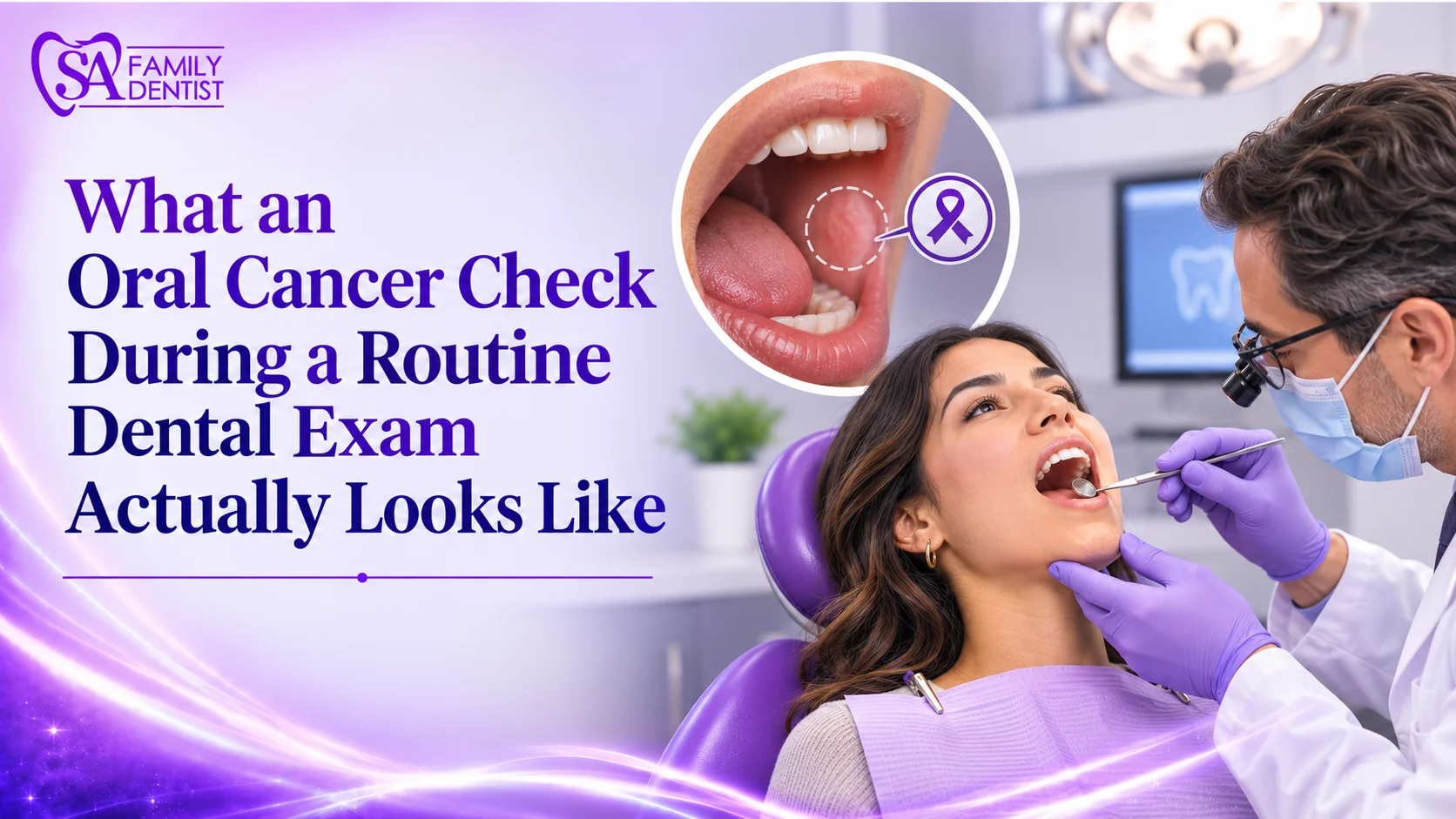
You’ve had the cleaning. The hygienist is done, the dentist leans in with that little mirror, and you’re staring at the ceiling thinking about lunch. Meanwhile, something else is happening in that chair: a quick look at parts of your mouth you probably never check yourself.
That’s the oral cancer check. It takes a couple of minutes, and most people never notice it.
Googling the best dentists in San Antonio, Texas? Then you’ve probably wondered what a good exam even includes. This is it, plus what your dentist is hunting for and what happens when something looks off.
What happens, step by step
Mostly looking, plus a little feeling. No needles. Nothing to prepare.
Outside first. Your dentist looks over your face and jaw, then presses gently along your neck and under your chin. They’re checking your lymph nodes for swelling, hardness, or one side feeling different from the other.
Then they move inside. Lips, cheeks, gums, the roof and floor of your mouth, the back of your throat. The tongue gets the most attention, sides and underneath included, because that’s where things hide. You might get a bit of gauze around it so your dentist can roll it side to side. Weird? Yes. Harmful? No.
Along the way, your dentist may ask about your history: tobacco, alcohol, how long a sore has been there. Screening lights and dyes can help highlight tissue changes in some cases, but the foundation is still a careful look and feel. If you’re curious about the tools used at your visit, just ask.
The whole thing usually takes a few minutes, and it’s painless. Some parts of the throat can’t be seen during a standard exam, so if that worries you, ask your dentist whether a specialist should take a look.
What your dentist is looking for
Here’s what your dentist is looking for: red, white, or black patches in the soft tissue of the mouth, and any sore that doesn’t heal within two weeks and bleeds easily, especially if it sticks around. Your dentist is also feeling for lumps and thickened areas.
In practice, that means keeping an eye out for:
- A sore or ulcer that hasn’t healed in two weeks
- Red or white patches that don’t go away
- Lumps or thickened areas
- Swollen or hard lymph nodes in the neck
- Numbness, or trouble chewing or swallowing
Early changes can be painless, which is why someone looking on purpose matters.
Most of what gets found is harmless
Deep breath here. Most mouth sores are not cancer. An infection, a cheek bite, a canker sore, or a rough tooth edge can all cause a spot that looks scary for a few days. These symptoms often have another cause, and the vast majority of what dentists find turns out to be harmless.
So if your dentist sees something small, a common move is to wait and watch. You come back in a couple of weeks to see if it healed. If it hasn’t, or it looks concerning, your dentist may recommend additional tests or refer you to a specialist, and a biopsy is how cancer is actually diagnosed. Extra tests don’t mean you have cancer, but it’s good to hear that up front. Our post on what a general dentist can treat before a specialist referral explains how that handoff works.
Sometimes the cause is something we can fix right in the chair. A sharp edge on a broken tooth or an old filling can keep irritating the same spot. Restorative dentistry can smooth that out.
Who should pay extra attention?
Anyone can get oral cancer, but some things raise the risk. Tobacco of any kind counts, including cigarettes, pipes, cigars, e-cigarettes, chewing tobacco, and snuff. Heavy alcohol use raises the risk too, and using both raises it even more. HPV has been linked to oral cancers, and risk goes up with age. Sun exposure can cause lip cancer, so don’t forget your lips under all that Texas sun. If you’d like a broader overview, there’s a head and neck cancer guide for patients.
If any of that sounds like you, mention it. It changes how closely your dentist looks and how often you should come in. Not sure how often that is? Here’s how often adults should see a general dentist.
Don’t wait for your next cleaning
Your mouth keeps changing between appointments. We wrote about why dental problems that can stay hidden without regular checkups.
If you notice a sore that hasn’t healed after two weeks, a white or red patch, a lump, numbness, or trouble swallowing, call us instead of waiting. Monthly self-exams are a good habit too. Look at your lips, cheeks, tongue, and gums in a mirror, and feel along your neck and jaw. A self-exam doesn’t replace a dentist, but it gives you a baseline.
Swelling that makes it hard to breathe or swallow needs urgent medical care. For dental pain or an injury, see our emergency dentistry page.
How to get the most out of your exam
Tell your dentist about anything you’ve noticed, even if it seems silly. Point to the spot. Ask, “Can you look closely at this one?” Ask what they checked and what happens if something needs follow-up. And if you feel rushed, say so.
Schedule a visit at SA Family Dentist
Looking for the best dentists in San Antonio, Texas? Ignore the ranking lists for a minute and think about who actually explains things. At SA Family Dentist, you can meet our doctors and ask them to talk you through your exam. We offer general dentistry at Braun Road, Nacogdoches Road, and Jackson Keller Road. No insurance? Ask about our Smile Club membership. Pick the closest office on our locations page and book when you’re ready.
Frequently asked questions
1. Is an oral cancer screening part of a routine dental exam?
It’s commonly part of a comprehensive exam. If you’re not sure, ask your dentist to include it and to explain what they’re checking.
2. Does an oral cancer check hurt?
No. It’s mostly looking and gentle feeling, and it usually takes a couple of minutes.
3. How often should I have one?
Many dentists look at your mouth for warning signs at every checkup, and a routine visit is a good time to have the exam. If you use tobacco, drink heavily, or have other risk factors, ask your dentist at SA Family Dentist how often you should be screened.
4. I don’t smoke or drink. Do I still need one?
Yes. Risk factors raise the odds, but they don’t rule anyone out. A quick check is part of looking after your whole mouth.
5. What if my dentist finds something?
Most findings turn out to be harmless. Your dentist may have you return in a couple of weeks to see if it heals, and if it doesn’t, they may recommend a biopsy or a referral to a specialist.
6. How do I find the best dentists in San Antonio, Texas for a thorough exam?
Look for a practice that asks about your history, explains what it’s checking, and tells you what comes next if something needs follow-up. Reviews can help, but how a team talks to you in the chair matters just as much.