
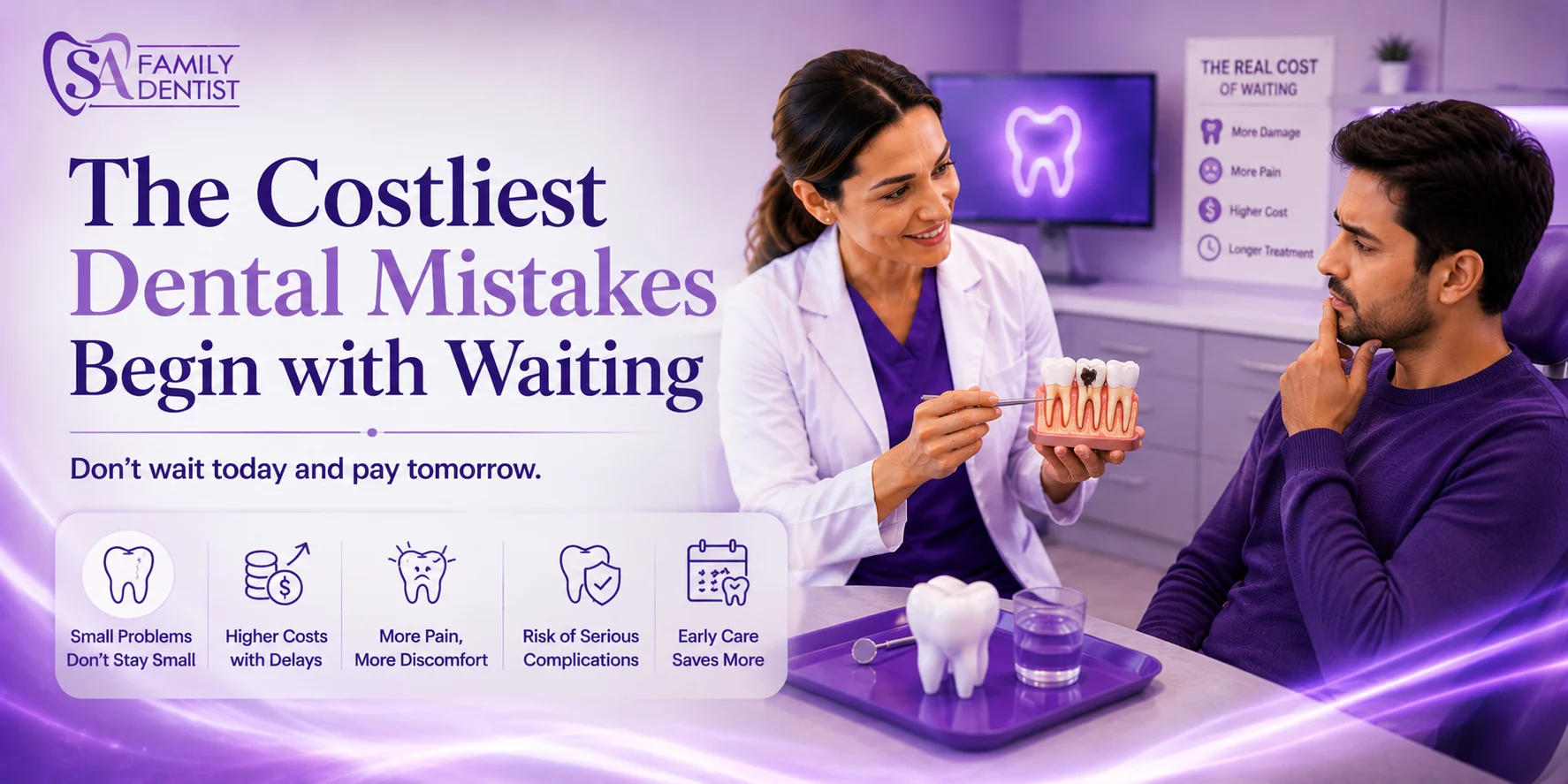
A month turns into three. Three becomes six. Six becomes a year of forgetting about it entirely until something hurts badly enough to force the issue. By then, the problem that would have cost a few hundred dollars to fix is now a few thousand. This pattern is so consistent across dental practices that most providers can predict it the moment a patient walks in and says “I’ve been meaning to come in for a while.” If you’ve been holding off on finding a dental clinic nearby, keep reading.
Waiting Isn’t Neutral. It’s A Decision With A Price.
People think of delay as the absence of a decision. It isn’t. Choosing to wait is choosing to let the problem develop on its own timeline, without any clinical intervention slowing it down.
Teeth don’t pause. Decay doesn’t pause. Gum disease doesn’t pause. The bacteria doing the damage are working continuously, and the only thing that interrupts that progression is treatment. Every month of waiting is a month of uninterrupted damage accumulation.
That reframe matters because most people who delay aren’t being reckless. They’re busy, money is tight, anxiety is real, nothing is hurting yet. The problem is that dental disease is specifically designed, evolutionarily, mechanically, to be painless until it isn’t. By the time it hurts, the easy intervention is usually gone.
The Five Scenarios Where Waiting Gets Expensive Fast
A Small Cavity Becomes A Root Canal
This is the most common version of the story. A cavity caught early is a filling. Small prep, straightforward procedure, done in under an hour. A cavity left for six to twelve months reaches the pulp, the nerve and blood vessel tissue at the center of the tooth. Now it’s a root canal followed by a crown.
The cost difference between a filling and a root canal plus crown is typically $1,500 to $2,500 depending on the tooth and location. That gap is entirely the product of waiting.
Gum Inflammation Becomes Gum Disease
Gingivitis, early gum inflammation, responds to professional cleaning. The bacteria get removed, the gums reattach, the problem is functionally resolved within a few weeks. A standard cleaning visit handles it.
Periodontitis is what gingivitis becomes when left alone for long enough. The infection moves below the gumline, bacteria colonize the pockets between gums and teeth, and bone starts eroding. Treatment shifts from a cleaning to scaling and root planing, a deep cleaning procedure done in sections, sometimes requiring local anesthetic. Ongoing maintenance appointments follow.
The time difference between these two outcomes is often six to twelve months of skipped visits. The cost difference is significant. And bone that’s lost to periodontitis doesn’t come back.
A Cracked Tooth Becomes An Extraction
Teeth crack. It happens from grinding, from biting something hard, from old fillings that have weakened the surrounding structure. A crack caught early, before it reaches the root, is treatable with a crown. The tooth is saved, protected, functional for years.
A crack that propagates to the root over months of continued chewing force changes the clinical picture entirely. Once the fracture is below the gumline and into the root, extraction is typically the only option. And extraction brings its own downstream costs: a gap that affects adjacent teeth, possible bone loss, and eventual implant placement if the space needs to be restored.
One crown versus one extraction plus one implant. The math isn’t close.
A Missing Tooth Stays Missing Too Long
People who lose a tooth and decide to leave the gap have a surprise waiting for them. Adjacent teeth drift toward the open space. The opposing tooth, with nothing to bite against, supererupts, it moves downward (or upward, depending on position) out of proper alignment. The jawbone beneath the missing tooth begins to resorb because it no longer receives the stimulation it needs.
By the time someone decides to address the gap a year or two later, the space has changed. Orthodontic work is sometimes needed to reopen it. Bone grafting may be required before an implant can be placed. What would have been a clean implant placement has become a more complex, more costly procedure.
Skipped Cleanings Let Everything Compound
This one doesn’t fit neatly into a single dramatic scenario because it operates more like compound interest, quietly, in multiple places at once. Two years without a cleaning means:
- Tartar buildup that has mineralized and can’t be removed by brushing
- Early decay on multiple surfaces that weren’t intercepted
- Gum pocketing that has deepened without anyone measuring it
- Old restorations that have been failing slowly with no one noticing
None of those things resolve on their own. They all get added to the treatment plan when someone finally walks into a dental clinic nearby and gets an exam.
The Anxiety Factor Deserves An Honest Mention
Dental anxiety is real and it’s common. A significant percentage of adults avoid dental care specifically because the visit itself is stressful. That’s not irrational, it’s a very human response to an experience that involves vulnerability, unfamiliar sounds, and someone working inside your mouth.
But anxiety-driven avoidance creates a compounding problem. The longer someone waits, the more treatment they need when they finally come in. The more treatment they need, the more intimidating the visit feels. The more intimidating it feels, the longer the next delay.
Breaking that cycle usually requires acknowledging it directly with a provider who can adjust the pace of the visit to accommodate it. Most good dental practices are set up for exactly that conversation.
What The Visit Actually Costs Versus What Waiting Costs
Here’s the clearest version of the comparison:
- Routine cleaning and exam: a predictable, manageable cost, twice a year
- Filling for a small cavity caught at that cleaning: straightforward, low cost
- Root canal plus crown because that cavity was skipped: several times higher
- Implant to replace a tooth that couldn’t be saved: significantly more still
Preventive dentistry is inexpensive relative to restorative dentistry. The math favors showing up regularly by a wide margin.
Stop Giving The Problem More Time To Work
At SA Family Dentist, patients who haven’t been in for a while get a thorough exam and a clear picture of what’s actually happening, not a judgment, not a lecture. If you’ve been searching for a dental clinic nearby and talking yourself out of calling, this is the nudge. Whatever is developing in your mouth right now is easier to address today than it will be next month.
Book an appointment with SA Family Dentist. Find out what’s there and what it takes to fix it before the list gets longer.
FAQs
1. Why is it risky to delay dental treatment for a few months?
Many dental problems continue to worsen even when they are not causing pain. Cavities can become deeper, gum disease can progress, and small cracks can grow larger, often leading to more complex and costly treatment later.
2. Can a small cavity become a root canal if left untreated?
Yes. If tooth decay reaches the pulp inside the tooth, a simple filling may no longer be enough. In these cases, root canal treatment followed by a crown may be needed to save the tooth.
3. What happens if I leave a missing tooth untreated?
Over time, neighbouring teeth can shift into the empty space, the opposing tooth may move out of position, and the jawbone in the area can gradually lose density. These changes can make future tooth replacement more complicated.
4. Are regular dental check-ups really necessary if my teeth feel fine?
Yes. Many dental conditions, including cavities, gum disease, and worn restorations, often develop without noticeable symptoms in their early stages. Regular examinations help detect and treat problems before they become more serious.
5. What should I do if dental anxiety has stopped me from booking an appointment?
Let the dental team know about your concerns when booking your visit. Many practices are experienced in helping anxious patients by explaining each step, working at a comfortable pace, and creating a more relaxed treatment experience.