
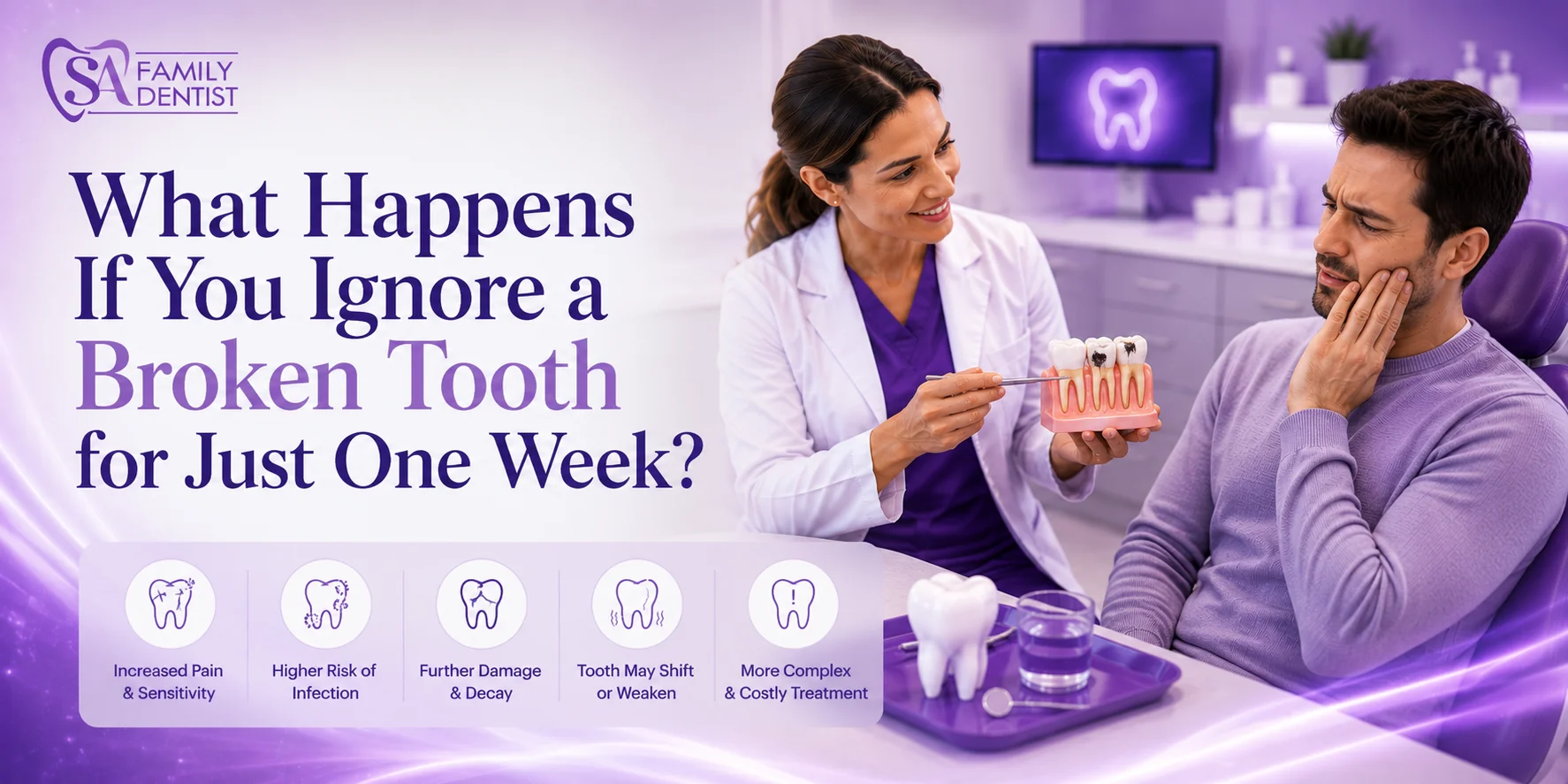
One week feels like nothing. It’s a long weekend, a busy stretch at work, a few days of telling yourself it doesn’t hurt that bad. But a broken tooth doesn’t wait. The clock starts the moment enamel cracks, and what happens inside that tooth over seven days is a lot more consequential than most people expect. If you’ve been putting off seeing an emergency dentist in San Antonio, this is worth reading before another day passes.
The First 24 To 48 Hours: What’s Already Happening
A broken tooth exposes layers that were never meant to see the outside world.
Enamel is the hard outer shell. Under it sits dentin, a porous layer full of microscopic tubules that run directly toward the nerve. When a break reaches dentin, temperature sensitivity starts almost immediately. Cold water hits differently. Hot food becomes a problem. That sharp, quick jolt isn’t random, it’s the nerve responding to stimulation through pathways that used to be insulated.
Within the first two days, bacteria in the mouth begin colonising the exposed surface. The mouth is not a sterile environment. It never is. And a crack or fracture gives bacteria a route they didn’t have before, into the tooth structure itself, not just along the surface.
This is where the one-week window starts getting clinically significant.
Days Three Through Five: The Infection Window Opens
Bacteria don’t need a week to cause real damage. Given access to dentin and proximity to the pulp, the soft tissue at the centre of the tooth containing nerves and blood vessels, infection can begin establishing within days.
A tooth infection doesn’t just hurt. It can progress into a dental abscess: a pocket of pus that forms at the root tip when the body tries to wall off a bacterial invasion it can’t clear on its own. Abscesses don’t resolve without intervention. They grow. The pressure builds. Pain that was intermittent becomes constant.
What a lot of people don’t realise:
- An untreated abscess can spread to the jaw, neck, or surrounding bone
- Facial swelling that comes with dental infection is not cosmetic, it’s a warning sign that infection is moving
- In severe cases, dental infections have led to hospitalization when bacteria reach the airway or bloodstream
None of this happens to everyone with a broken tooth. But it happens to people who wait. The ones who thought seven days was manageable.
The Structural Damage Compounds Daily
Beyond infection, there’s a mechanical problem with waiting.
A broken tooth is a weakened tooth. The crack changes how force distributes across the remaining structure every time you chew. What started as a clean break can propagate, the fracture line extends deeper with each bite. A crack that stops short of the root on day one is not guaranteed to stay there on day seven.
When a fracture reaches the root, the calculation changes entirely. A tooth that could have been saved with a crown, a straightforward restorative procedure, now requires extraction. That’s not a scare tactic. That’s the clinical reality of crack propagation in a tooth under daily mechanical load.
Time doesn’t pause the damage. It adds to it.
When Pain Disappears, The Situation Often Gets Worse
Here’s the part that catches people off guard.
A broken tooth sometimes stops hurting. Not because it’s healing, teeth don’t heal themselves, but because the nerve has died. Pulp necrosis, the technical term, means the nerve tissue inside the tooth has been destroyed, often by bacterial infection or the trauma of the break itself.
No pain. So people assume the problem resolved.
What’s actually happening: the infection continues without the warning signal. Dead pulp is a feeding ground for bacteria. The abscess forms quietly. By the time pain returns, and it does return, the infection is further along, the tooth is in worse shape, and treatment is more involved than it would have been a week earlier.
Disappearing pain after a dental injury is not reassurance. It’s a reason to move faster, not slower.
What An Emergency Dentist Actually Does In This Situation
Seeing an emergency dentist in San Antonio within the first day or two of a break gives the provider the most options.
Depending on how much tooth structure remains and whether the pulp is involved, treatment paths include:
- Dental bonding or a crown, if the break is above the gumline and the nerve is intact, a crown can cap and protect the remaining structure
- Root canal therapy followed by a crown, if the pulp is infected or exposed, the nerve gets removed, and the tooth gets sealed before restoration
- Extraction, if the fracture has reached the root or infection has progressed past the point of salvage, removal becomes the practical answer
The earlier the visit, the more likely the first option, and the less likely the third.
The Week In Summary
It’s worth being clear about what seven days of waiting actually represents:
- Bacterial colonisation that begins in the first 48 hours
- A real infection window that opens by day three
- Daily crack propagation under normal chewing force
- A potential nerve death that masks the problem’s progression
- A narrowing set of treatment options as each day passes
That’s a lot of ground lost for one week of avoidance.
Don’t Let The Window Close
At SA Family Dentist, same-day emergency appointments exist for exactly this reason. A broken tooth that looks minor on the surface deserves a quick look from a provider who can tell you whether it actually is. If you’ve been searching for an emergency dentist in San Antonio and keep putting it off, today is the right day to stop doing that.
Call SA Family Dentist or book online. A five-minute decision now is worth a lot more than an avoidable procedure later.
FAQs
1. Is a broken tooth considered a dental emergency?
Yes. A broken tooth should be assessed as soon as possible, especially if it causes pain, sensitivity, bleeding, or has a sharp edge. Prompt treatment can help prevent infection and reduce the risk of further damage.
2. Can I wait a few days before seeing a dentist for a broken tooth?
Even if the damage seems minor, delaying treatment can allow bacteria to enter the tooth and increase the likelihood of complications. Seeing a dentist promptly gives you the best chance of preserving the tooth.
3. What should I do immediately after breaking a tooth?
Rinse your mouth gently with warm water, avoid chewing on the affected side, and keep any broken pieces if possible. If there is swelling, apply a cold compress to the outside of your face and arrange a dental appointment as soon as you can.
4. Will a broken tooth heal on its own?
No. Unlike some other parts of the body, a broken tooth cannot repair itself. Professional treatment is needed to restore the tooth and protect it from further damage or infection.
5. What treatments are available for a broken tooth?
Treatment depends on the severity of the fracture. Options may include dental bonding, a crown, root canal therapy followed by a crown, or extraction if the tooth cannot be saved. A dentist will recommend the most appropriate treatment after an examination.