
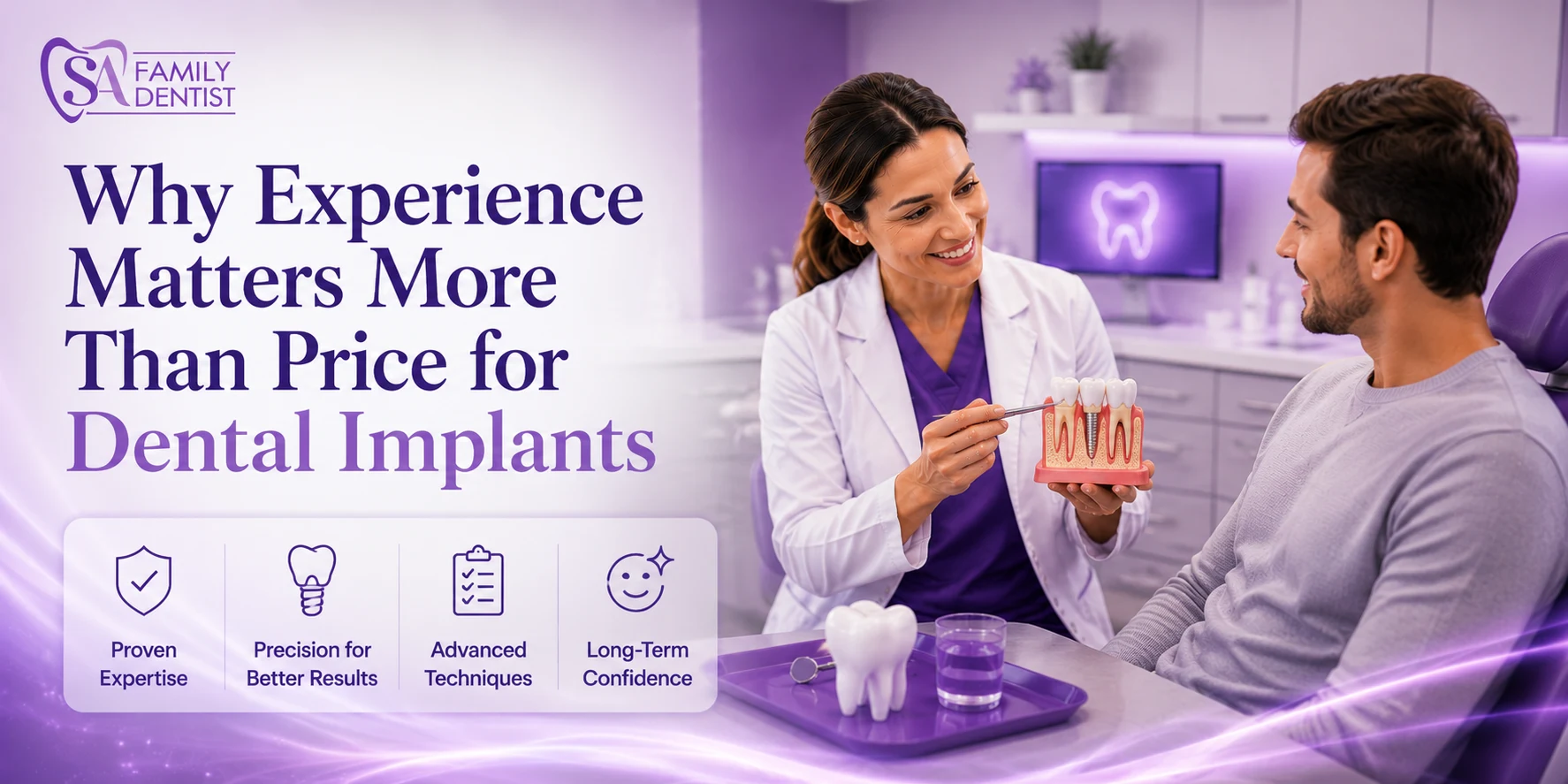
Most people start their dental implant search the same way. They Google it, they get sticker shock, and they immediately start looking for the cheapest option. That instinct makes sense, implants aren’t cheap. But when you’re talking about a procedure that gets drilled into your jawbone, “who’s least expensive” is probably the wrong first question. If you’re already researching the best dental implants in San Antonio, TX, here’s what the price-first approach usually costs people in the long run.
The Problem With Shopping Implants Like You Shop For Tires
A tire wears out. You replace it. No big deal.
An implant, done right, is supposed to last 20 to 30 years. The American Academy of Implant Dentistry puts the long-term success rate of implants above 95%, but that number assumes proper placement, the right bone assessment, and a clinician who has done this enough times to know when something is off before it becomes a failure.
When an implant fails, you don’t just lose the implant. You often lose bone. And bone loss is the thing that makes the second attempt harder, costlier, and less predictable than the first.
This is where experience stops being a soft, feel-good credential and starts being a very clinical number.
What Experience Actually Changes About The Procedure
There’s a meaningful difference between a dentist who has placed 20 implants and one who has placed 2,000. It shows up in ways patients often don’t think to ask about:
- Bone density assessment: An experienced provider reads the scan and knows when there’s not enough bone for a standard placement. A less experienced one proceeds anyway. The result is a loose implant that fails in 18 months.
- Implant positioning: Angle matters. Depth matters. How load is distributed across the jaw matters. These are judgment calls that improve with repetition, not things you learn from a course.
- Complication recognition: Problems rarely announce themselves. They show up as subtle signs in healing. Catching them early is a skill. It’s not something a checklist teaches.
- Material and system selection: Not all implant systems are equal. Experienced providers have worked across enough systems to match the right one to the patient’s anatomy, not just default to whatever’s on the shelf.
The price you see quoted rarely reflects any of this. It reflects materials and time. Experience is the variable that doesn’t show up in the estimate.
The Real Cost Math
Say you save $800 going with a lower-cost provider. The implant fails two years later. Now you’re looking at:
- Removal of the failed implant
- Bone grafting if density is compromised
- Healing time (often several months)
- Placing a new implant from scratch
Total additional cost? Frequently $3,000 to $5,000, depending on the extent of bone loss. And that’s not accounting for the time off work, the discomfort, or the fact that you now have to start trusting a new provider all over again.
It’s not that low-cost providers always fail. Some are genuinely skilled and offer honest value. The issue is that price alone tells you nothing about skill level, and dental implants are one of the procedures where that distinction matters most.
Questions Worth Asking Before You Book
If you’re evaluating providers for the best dental implants in San Antonio TX, ask these before the consultation is over:
- How many implants have you placed?
- What imaging technology do you use (3D cone beam CT vs. traditional X-ray)?
- What happens if the implant fails, what’s your protocol?
- Do you handle bone grafting in-house or refer out?
- Can I see examples of completed cases?
A confident, experienced provider won’t hesitate on any of these. Hesitation, vagueness, or deflection is information.
Technology Is Part Of The Experience Gap
Modern implant placement isn’t just clinical skill. It’s also about what tools the clinician is working with. 3D imaging changes what a provider can see before the first incision. Digital treatment planning reduces margin for error. Guided implant surgery, where it’s appropriate, narrows placement deviation to fractions of a millimetre.
These aren’t luxury add-ons. They’re risk-reduction tools. A provider who has both the experience to interpret the imaging and the equipment to act on it is a meaningfully different offering than one without either.
Where Does The SA Family Dentist Fit In?
If you’re looking for the best dental implants in San Antonio, TX, SA Family Dentist offers implant services backed by advanced diagnostic imaging and a team that treats implant cases as part of a complete, long-term care relationship, not a one-time transaction. Their approach puts clinical outcomes above quick turnaround.
Patients who’ve been searching for a provider they can trust for a decision this permanent deserve a team with the depth to back that trust up.
The Bottom Line
An implant is a long-term investment in your jaw, your bite, and your quality of life. Price matters. It would be dishonest to say otherwise. But when experience is the variable that separates a 25-year implant from a failed one, letting price be the deciding factor is a trade-off most people regret.
Find someone who has done this enough times that they know what can go wrong. Because they will recognise it before you feel it.
Ready to talk implants with a team that takes the long view? Book a consultation with SA Family Dentist and find out what the right approach looks like for your specific case.
FAQs
1. Why is experience important when choosing a dental implant provider?
Experience plays a significant role in implant success. An experienced clinician is better equipped to assess bone quality, position implants accurately, identify potential complications early, and develop a treatment plan tailored to each patient’s needs.
2. Are cheaper dental implants always a good option?
Not necessarily. While some lower-cost providers deliver excellent care, price alone does not reflect the provider’s experience, technology, or treatment quality. It’s important to evaluate qualifications and long-term outcomes alongside cost.
3. What technology is commonly used for dental implant planning?
Many experienced providers use 3D cone beam CT (CBCT) scans and digital treatment planning to evaluate bone structure, determine optimal implant placement, and improve treatment accuracy before the procedure begins.
4. How long can dental implants last?
With proper placement, good oral hygiene, and regular dental check-ups, dental implants can last for decades. Long-term success depends on several factors, including the patient’s oral health, lifestyle, and the quality of the treatment provided.
5. What questions should I ask during a dental implant consultation?
Ask about the provider’s experience with implant procedures, the imaging technology they use, whether they perform bone grafting if needed, how they manage complications, and whether they can share examples of previous implant cases.