
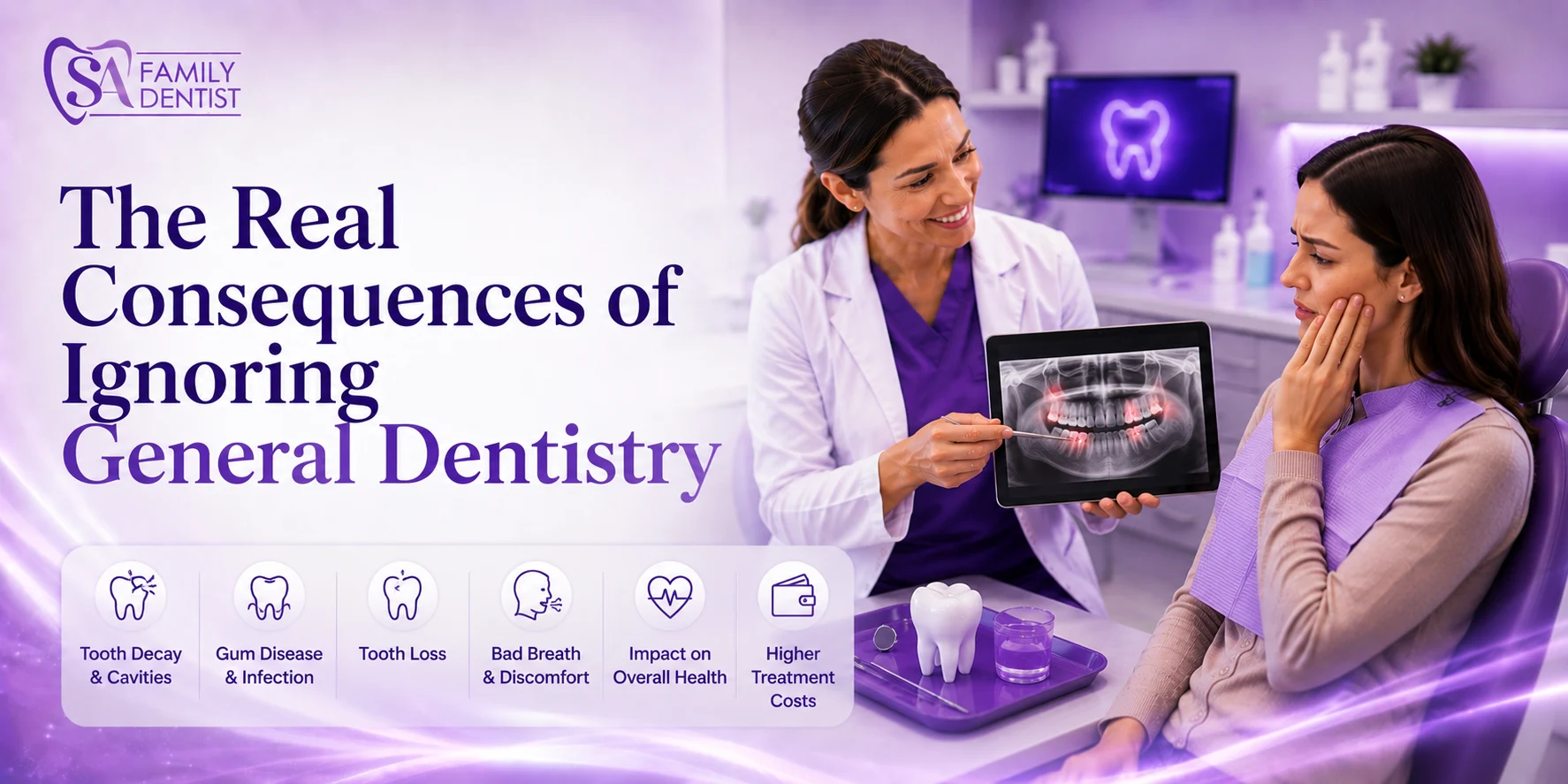
Six years. That’s how long one patient told us it had been since her last cleaning, sitting in the chair half-apologizing before we’d even looked at an X-ray. She wasn’t avoiding general dentistry out of carelessness. Life happened, a move, a job change, no insurance for a stretch, and six months became six years almost without her noticing.
This happens more than people admit out loud. And the mouth doesn’t wait politely for you to get around to it.
The First Year Nobody Notices Anything
This is the dangerous part. Skip a cleaning or two and most mouths feel completely fine. No pain, no obvious problem, nothing that screams “go fix this.” Plaque builds along the gumline where a toothbrush can’t quite reach it, and it hardens into tartar that only a dental tool can remove.
Small cavities start the same way, invisible, painless, easy to ignore. By the time a cavity hurts, it’s usually not small anymore.
Years Two And Three: Gum Disease Gets A Foothold
Untreated tartar buildup irritates gum tissue. At first it’s gingivitis, gums that bleed a little when you brush, maybe look slightly puffy. Reversible, mostly, with a proper cleaning.
Left alone, gingivitis can progress into periodontitis, and that’s where things stop being reversible:
- Gums start pulling away from the teeth, forming pockets where bacteria collect
- Bone supporting the teeth begins to break down, slowly
- Teeth can loosen even though nothing visibly looks wrong from the outside
- Bad breath becomes persistent rather than occasional
People often blame the bad breath on diet or stress. It’s frequently neither.
Why is this stage so quiet?
There’s rarely sharp pain at this point. Periodontitis tends to be a slow leak, not a flood. That’s exactly why general dentistry visits matter even when nothing hurts, a dentist catches the bone loss on an X-ray long before you’d ever feel it.
Year Four: Cavities Turn Into Something Bigger
A cavity ignored long enough reaches the nerve. That’s when a routine filling stops being an option and a root canal becomes the conversation instead. Some teeth, by this stage, can’t be saved at all.
Extraction isn’t just about losing one tooth either. Missing teeth shift the bite. Neighboring teeth drift toward the gap, and the opposing tooth above or below can grow slightly longer over time because it’s no longer meeting resistance. One missing tooth quietly destabilizes the ones around it.
Years Five And Beyond: The Body Starts Paying Attention Too
This is the part that surprises people most. Oral health isn’t separate from the rest of the body, research has linked chronic gum disease to complications with heart health and blood sugar control. We’re not here to diagnose anything beyond the mouth, but the connection is real enough that it changes how seriously a long gap should be taken.
By this point, a patient walking back in after years away is often looking at:
- Multiple cavities requiring fillings or crowns, not just one
- Deep cleanings (scaling and root planing) instead of a standard cleaning
- Possible gum surgery if pocket depth has gotten severe
- Tooth loss that now needs a bridge, implant, or denture conversation
None of this is meant to scare anyone out of walking through the door. It’s meant to explain why the door matters.
Conclusion
The good news, and there is good news, is that the mouth is forgiving up to a point. A first visit back after a long gap usually starts with X-rays and an honest look at where things stand, no judgment, just information. From there, most patients land in one of two categories: a deeper cleaning to get gum health back on track, or a more involved plan if a few teeth need attention first.
Either way, the visit that feels hardest to schedule is usually the one that matters most.
At SA Family Dentist, we see patients coming back after long gaps more often than people might think, and there’s no lecture waiting for you at the door. Our team in San Antonio focuses on getting you back on track with a clear, judgment-free plan built around where your mouth actually is today. If it’s been a while, book a visit and let’s start there.
FAQs
1. Is it really a problem if I haven’t been to the dentist in a few years but nothing hurts?
Yes. Many dental issues, including cavities and gum disease, can develop without causing pain in the early stages. Regular check-ups help identify problems before they become more serious and costly to treat.
2. What are the first signs of gum disease?
Common early signs include bleeding gums when brushing or flossing, persistent bad breath, swollen gums, and gum tenderness. Early treatment can often reverse the condition before it progresses.
3. Can dental problems become more expensive if I delay treatment?
In many cases, yes. A small cavity that could have been treated with a filling may eventually require a root canal, crown, or even tooth extraction if left untreated for too long.
4. What should I expect during my first dental visit after several years?
Your dentist will typically perform a comprehensive examination, take X-rays if needed, assess your gum health, and create a personalised treatment plan based on your current oral health needs.
5. Is it ever too late to get my oral health back on track?
No. While some damage may not be reversible, many dental problems can be managed or treated effectively. Returning to the dentist is the first step toward improving and maintaining your oral health.