
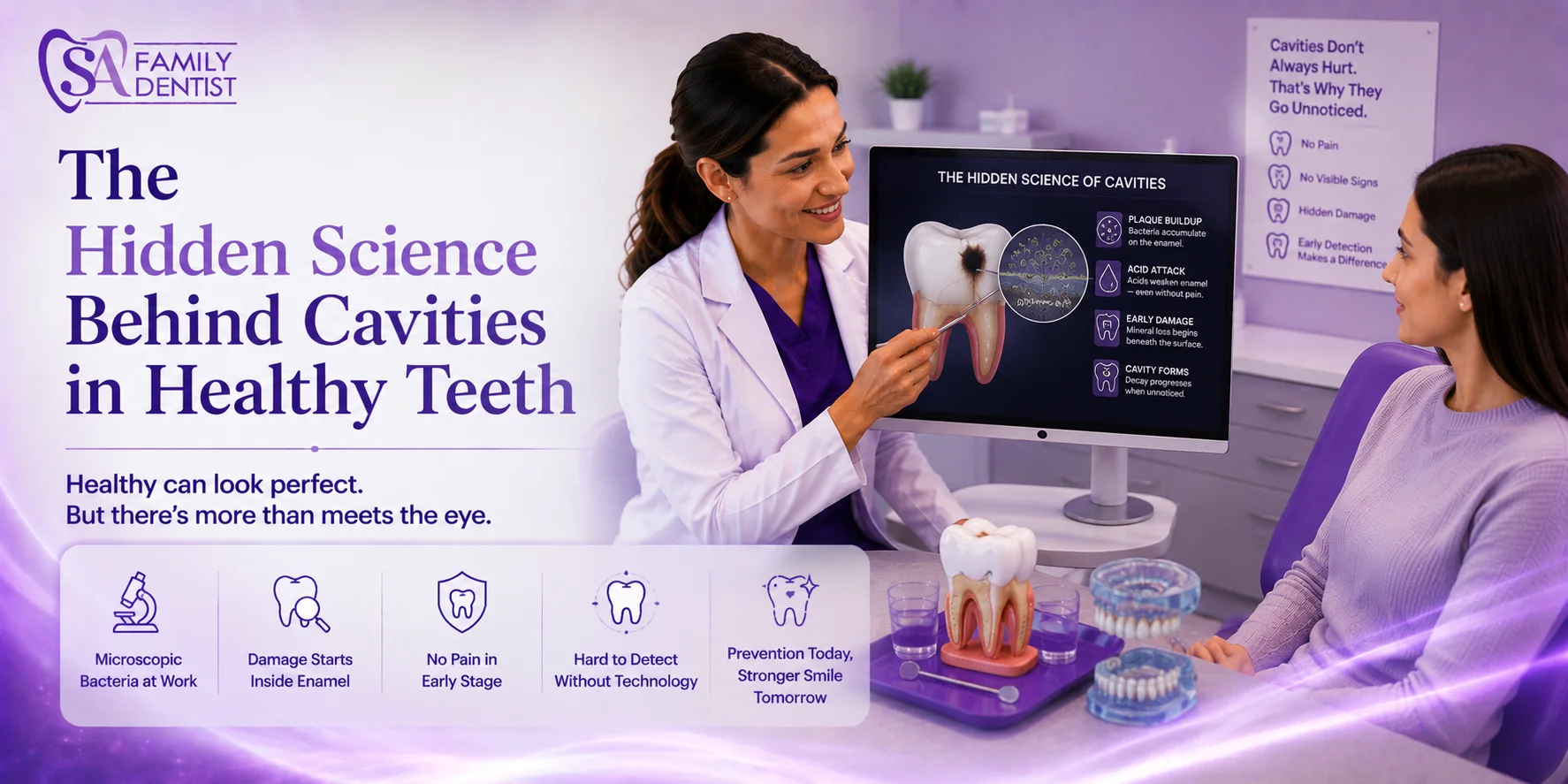
You brush twice a day. You floss. You haven’t had a soda in years. And then you sit in a dental chair and hear that you have two new cavities. It doesn’t make sense, or at least it doesn’t make sense if you’re operating on the assumption that cavities are just what happens to people who don’t take care of their teeth.
That assumption is incomplete, and most patients never get the fuller explanation. A good general dentist in San Antonio should be having this conversation. Here’s what it actually involves.
Cavities Are An Infection, Not A Failure Of Hygiene
This is the reframe that changes everything.
Dental decay is caused by specific bacteria, primarily Streptococcus mutans and Lactobacillus species, that live in the mouth, consume sugar, and produce acid as a byproduct. That acid demineralises enamel. When demineralisation outpaces the mouth’s natural remineralisation process, a cavity forms.
Brushing and flossing reduce the bacterial load and remove food sources. They are genuinely important. But they don’t eliminate the bacteria, don’t change the mouth’s pH environment on their own, and don’t address the other variables that determine whether decay forms. Someone can have excellent oral hygiene habits and still carry a high concentration of S. mutans. Someone with mediocre hygiene but favourable saliva chemistry and low bacterial load can go years without a cavity.
Hygiene is one variable in a multi-variable equation. Treating it as the only one is why conscientious patients end up confused in a dental chair.
The Variables Most Patients Don’t Know About
Saliva Quality And Flow Rate
Saliva is the mouth’s primary defence against decay. It buffers acid, delivers calcium and phosphate for remineralisation, and mechanically clears bacteria and food debris from tooth surfaces. When saliva production is adequate and its chemistry is right, it does a substantial amount of protective work between brushings.
When it isn’t, because of medication side effects, chronic mouth breathing, dehydration, or certain systemic conditions, the protective function drops significantly. Patients on antidepressants, antihistamines, blood pressure medications, or diuretics frequently experience dry mouth as a side effect. That reduction in saliva is not a hygiene problem. It’s a physiological change that meaningfully increases cavity risk regardless of how carefully someone brushes.
Tooth Anatomy And Surface Geometry
Not all teeth are equally easy to clean. Back molars have deep pits and fissures on their chewing surfaces, grooves that are sometimes narrower than a single toothbrush bristle. Bacteria and food particles sit in those grooves and stay there regardless of brushing technique, because the bristle physically cannot reach the base of the groove.
This is why sealants exist. A thin resin coating applied to those surfaces fills the groove and eliminates the protected space where decay starts. Patients who had sealants placed as children and then lost them as adults, sealants eventually wear and fall out, are sometimes surprised to find cavities developing in teeth that were previously protected for 15 years.
Tooth anatomy is genetic. It isn’t something brushing can change.
Bacterial Transmission
- mutans is transmissible. It passes between people through shared saliva, a spoon, a drink, or kissing. Parents with high S. mutans counts can transmit the bacteria to young children during routine caregiving, which partly explains why some families seem to have generational patterns of dental decay while others don’t.
Adults can also shift their bacterial profile through new relationships. This is not a commonly discussed aspect of dental health, but it’s clinically documented and worth knowing if someone who hasn’t had cavities in years suddenly develops them after a life change.
The Frequency Of Sugar Exposure Matters More Than The Amount
This is one of the more useful pieces of science to understand, and most patients never hear it.
The mouth recovers from a sugar exposure in roughly 20 to 30 minutes, once saliva neutralises the resulting acid drop. One soda with a meal gives the bacteria one feeding opportunity and the mouth one acid recovery period.
Sipping the same soda slowly over two hours gives the bacteria continuous feeding and keeps the oral environment acidic for the entire duration. From a decay perspective, those two scenarios are completely different even though the sugar intake is identical.
This is why the pattern of consumption, frequency and duration, predicts cavity risk better than total sugar consumption alone. A patient who eats dessert once a day is in a different position than a patient who sips sweet coffee from a travel mug for three hours every morning.
Genetic Factors In Enamel Strength
Enamel quality varies genetically. Some people have naturally denser, harder enamel that resists demineralisation at lower pH levels. Others have softer enamel that responds more readily to acid exposure. This is not visible, not diagnosable from a standard exam, and not correctable, but it’s real and it affects individual cavity risk in ways that hygiene alone can’t compensate for.
Patients who’ve always done everything right and still develop decay often fall into this category. The explanation isn’t that they’re doing something wrong. It’s that their enamel operates at a different baseline than average.
What A Full Risk Assessment Looks Like
A general dentist in San Antonio who understands cavity formation as a multi-variable process doesn’t just treat the cavities that form. They assess the conditions producing them:
- Saliva flow and quality, sometimes measured, sometimes inferred from symptoms and medication history
- Dietary pattern review, frequency of sugar and acid exposure, not just total intake
- Existing sealant status and whether reapplication makes sense
- Fluoride exposure, topical fluoride has a well-documented remineralisation effect that works independently of brushing
- Recall frequency, high-risk patients benefit from more frequent cleanings and monitoring, not the same twice-a-year schedule as low-risk patients
That conversation changes the treatment plan from reactive to preventive. Which is where the useful clinical work happens.
Knowing Why Makes The Difference
At SA Family Dentist, the exam isn’t just a count of what needs to be filled. The conversation about why decay is forming, what the specific risk factors are for that patient, is part of what a good visit produces. If you’ve been doing everything right and still ending up with cavities, you deserve a general dentist in San Antonio who can explain why and actually address the underlying conditions.
Book an appointment at SA Family Dentist. Walk out with a clear picture of your cavity risk, not just a treatment plan.
FAQs
1. Can I still get cavities if I brush and floss every day?
Yes. Good oral hygiene is essential, but it is only one factor that influences cavity risk. Saliva quality, diet, tooth anatomy, genetics, dry mouth, and the types of bacteria in your mouth can all contribute to tooth decay.
2. Why does dry mouth increase the risk of cavities?
Saliva helps wash away food particles, neutralise acids, and support enamel remineralisation. When saliva production is reduced, harmful bacteria and acids remain on the teeth for longer, increasing the likelihood of decay.
3. Does eating sugar often matter more than how much sugar I eat?
In many cases, yes. Frequent snacking or sipping sugary drinks throughout the day keeps the mouth acidic for longer periods, giving cavity-causing bacteria more opportunities to damage tooth enamel.
4. Are some people naturally more likely to develop cavities?
Yes. Genetics can influence enamel strength, tooth shape, saliva composition, and even how susceptible a person is to tooth decay. This is why some people develop cavities despite maintaining excellent oral hygiene.
5. How can a dentist determine my individual cavity risk?
Your dentist will assess factors such as your oral hygiene habits, dietary patterns, saliva flow, medical history, existing restorations, fluoride exposure, and previous history of tooth decay. This information helps create a personalised prevention plan to reduce your future risk of cavities.