

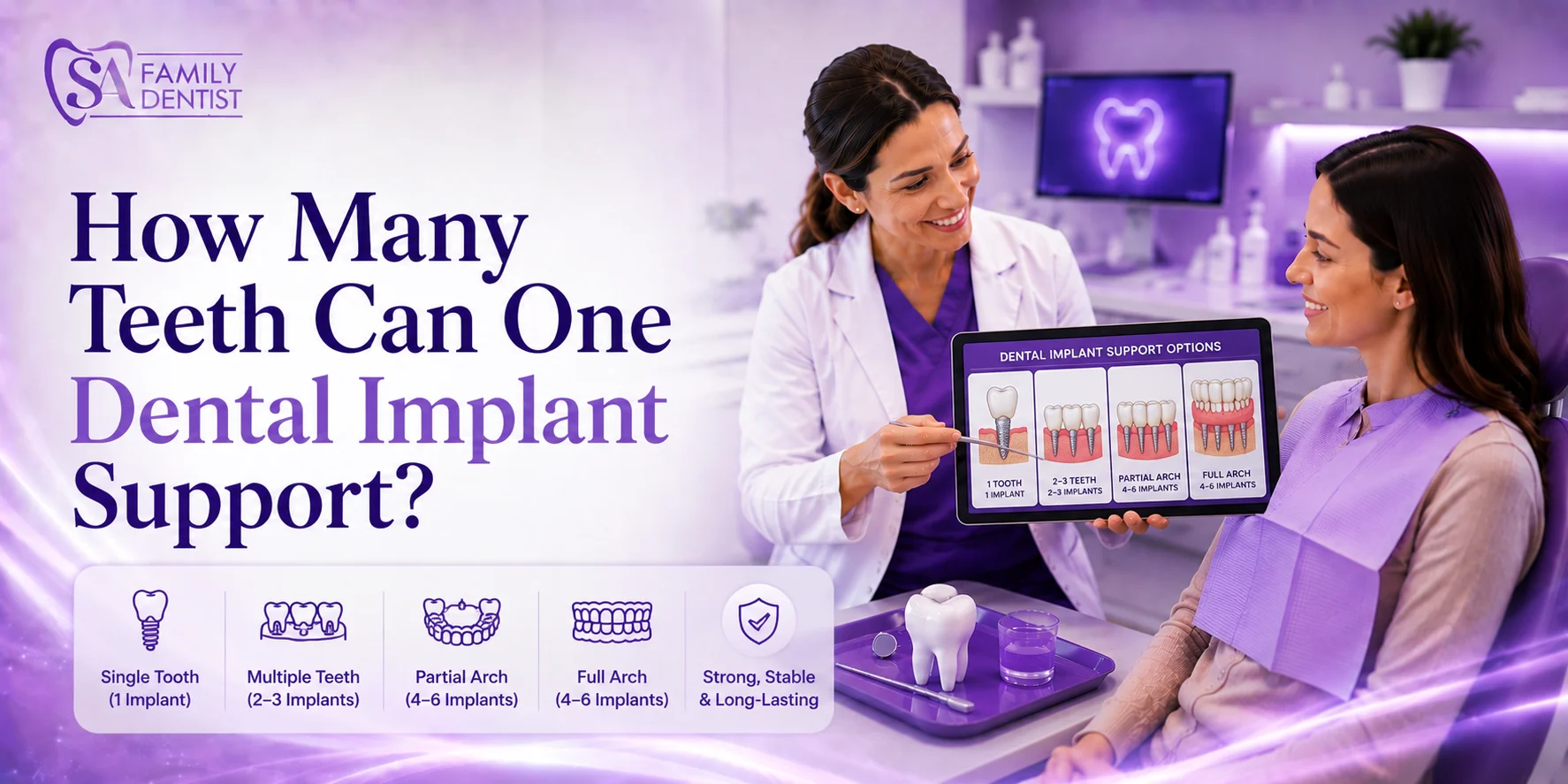
One implant. Up to fourteen teeth. That range surprises almost everyone who hears it for the first time, including patients who’ve already done a fair amount of research before walking in. The honest answer to “how many teeth can one implant hold” depends entirely on which situation someone’s actually in, which is exactly why this question comes up so often around best dental implants in San Antonio, TX, people are usually trying to figure out which version of implants applies to them, not implants in general.
There isn’t one answer here. There are three, and they solve different problems.
One Implant, One Tooth
This is the simplest version and the one most people picture when they hear the word “implant.” A single titanium post replaces the root of one missing tooth, and a crown sits on top to replace the visible part.
It’s a one-to-one swap. One implant supports exactly one tooth, nothing more. This works well when someone’s lost a single tooth and the teeth around it are otherwise healthy and don’t need anything done to them.
The appeal here is precision. Neighboring teeth aren’t touched, aren’t filed down, aren’t involved in the fix at all. Just the one spot gets addressed.
Where this approach stops making sense
If someone’s missing several teeth in a row, doing a separate implant for every single one gets expensive fast, and it’s often not necessary anyway. That’s where the next option comes in.
One Implant Supporting Several Teeth
Here’s where the math gets more interesting. A single implant can anchor a small bridge, supporting two or three teeth instead of just one. Two implants placed strategically can support a bridge spanning three to four teeth. The implants act as anchor points, and the bridge fills in the gaps between them.
This matters for a specific reason: not every missing tooth needs its own implant. If three teeth in a row are gone, that doesn’t automatically mean three separate procedures. Two well-placed implants, sometimes even one depending on the situation, can support all three replacement teeth using a connected bridge.
A few things determine whether this approach fits:
- How many teeth are missing in that section
- The condition of the jawbone in that specific area
- Whether the gap is in a spot that handles regular biting force, like back molars, or a lighter-pressure area
Get the placement and engineering right, and a bridge supported by implants functions close to natural teeth for chewing and daily use.
All-On-X: When It’s The Whole Arch
This is where the numbers get the most dramatic, and it’s also the option that surprises people the most. All-on-X uses as few as four to six implants to support an entire arch of teeth, meaning all the upper teeth or all the lower teeth at once.
Instead of one implant per tooth, which would mean a dozen or more implants for a full arch, four to six implants placed at specific angles and positions can support twelve to fourteen replacement teeth. The implants don’t need to match the tooth count one-to-one here. They need to be positioned correctly to distribute the bite force across the whole arch.
This option exists for people who’ve lost most or all of their teeth in an arch, whether from years of decay, gum disease, or a combination of dental issues over time. It’s a full-arch solution built around a much smaller number of implants than people initially expect.
Conclusion
The real question isn’t “how many implants do I need.” It’s “how many teeth am I actually missing, and where.” One missing tooth, one implant. A few in a row, possibly two implants with a bridge. An entire arch, four to six implants doing the work of replacing everything.
Knowing which category someone falls into changes the entire conversation, the cost, and the timeline.
At SA Family Dentist, we figure out exactly which of these three situations fits before recommending anything. Whether it’s one tooth or a full arch, the right number of implants depends on what’s actually missing, not a one-size answer. If you’re exploring the best dental implants in San Antonio, TX.
Book a consultation and we’ll map out what your specific case actually needs
FAQs
1. Can one dental implant support more than one tooth?
Yes. While a single implant is often used to replace one missing tooth, it can also support a dental bridge that replaces multiple teeth, depending on the location and overall treatment plan.
2. Do I need one implant for every missing tooth?
Not necessarily. In many cases, two or more implants can support a bridge that replaces several missing teeth, reducing the total number of implants needed.
3. What is the All-on-X implant system?
All-on-X is a full-arch tooth replacement solution that uses a strategically placed set of implants—typically four to six—to support an entire upper or lower arch of replacement teeth.
4. How many teeth can All-on-X implants support?
An All-on-X restoration can typically support a full arch of around 12 to 14 replacement teeth using only a small number of implants placed in key positions within the jaw.
5. How do dentists determine how many implants I need?
The number of implants depends on several factors, including how many teeth are missing, where they are located, the condition of the jawbone, and the type of restoration being used. A dental consultation and imaging evaluation can determine the most appropriate treatment plan.